David Starr, Space Ranger
Series: Lucky Starr 1
Reviewed date: 2026 Jul 2
Rating: 3
144 pages
Isaac Asimov writing as Paul French
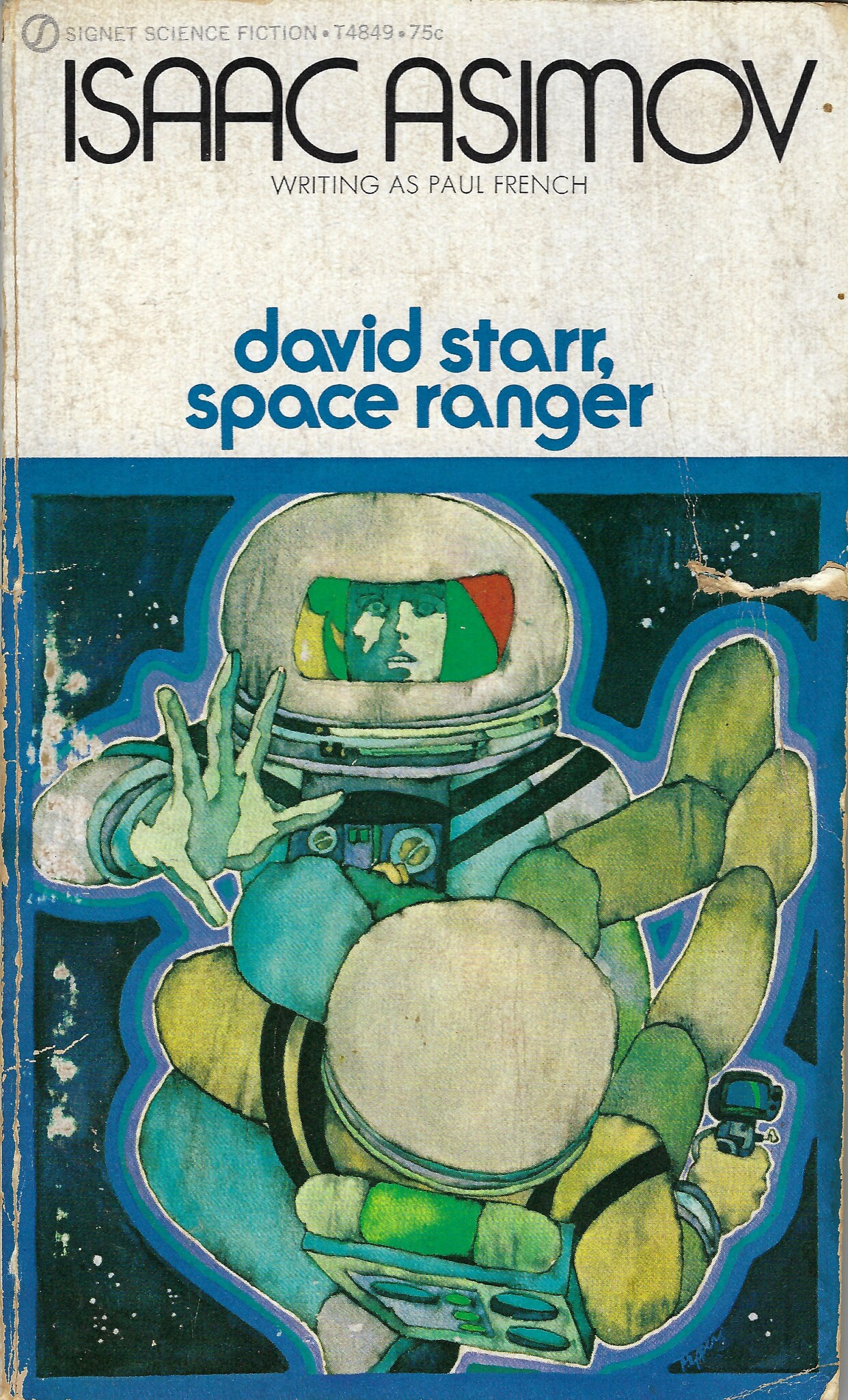
Poisoners and interplanetary politics
This is clearly a juvenile, but Asimov sure can write. David Starr, a newly minted agent of the Council of Science, cracks an interplanetary food poisoning plot that threatens the stability of the entire solar system. Someone has been poisoning food imports from Mars. This is a geopolitical crisis because Earth is unable to feed itself: its six billion inhabitants rely on imports, mainly from Mars. If the citizens of Earth stop eating Mars food out of fear, starvation will ensue.
A side note: I find it interesting that in 1952 Asimov found it reasonable to predict that Earth could not support as many as six billion people. In 2026 we have well over 8 billion and there is plenty of food. It's not always evenly distributed, but that's a political problem, not a food supply problem.
Council of Science, Galactic Patrol?
Parts of the plot remind me of the Lensman series. Instead of a Galactic Patrol that serves as a force for good in the entire galaxy, we have the Council of Science that serves as a force for good in the entire solar system. Our hero isn't a Gray Lensman named Kinnison who is pals with the President and the Port Admiral, he's an orphan named David Starr who is the surrogate son of the Chief Councilor Hector Conway and Councilman Augustus Henree. Like a Gray Lensman, though, Starr is given free rein to operate wherever and however he sees fit.
There are other points of similarity, too.
- Sidekick: Kinnison has Van Buskirk, a sidekick who isn't a Lensman but is basically good enough to be one. Starr pals around with Bigman Jones, who isn't technically a Councilman but might as well be.
- Like a Lensman, Starr visits a race of disembodied super-intelligences and receives a mystical talisman that gives him super-powers.
- Space pirates figure prominently in the series. (More so in the second book than in the first.)
- Members of the Council of Science have a thought-controlled skin tattoo that serves as an un-counterfeitable form of identification, much like the uncounterfeitable Lens of Arisia.
I'm probably reading too much into these points of similarity, but I also know I'm not the first to make the connection. Fortunately, Asimov doesn't turn this into a Lensman copy.
Bigman, Hennes, and Benson
Where better to investigate the poisoning of Martian food imports than at the source? David Starr goes undercover as a farm boy on a big Martian farm. He makes a friend in John "Bigman" Jones, an enemy of foreman Hennes, and an ally in agronomist Benson. It's Benson's theory that the poisonings are the work of native Martians who are angry about humans colonizing their planet. The others dismiss his theory because nobody has ever seen a native Martian: they don't exist.
Magic Martians
Of course David Starr finds the elusive non-existent Martians. They are not the poisoners: the Martians have long since abandoned their physical forms and now exist as beings of pure energy. They are content to exist in caverns deep below the surface of Mars while they explore realms of Inner Life of the mind. They are unconcerned with humanity. The Martians give David a gift: a personal force-shield that also makes him invisible.
Superhero origin story
Wait, is this a superhero origin story? David has a personal force-shield that makes him invincible and invisible! Fortunately, no. David uses it a few times in this book and the next, then Asimov wisely drops it.
Space Ranger
But before Asimov drops it, David uses the force-shield to don a secret identity: he is the Space Ranger, an invisible superhero who unmasks the real culprit behind the poisonings: it was Benson all along. He was disgruntled because the others looked down on him for being a mere "college farmer" and not a real man of the soil. And being a college-educated agronomist employed at a major Martian farm, Benson had the knowledge and skills to create a poison as well as the access to slip it into the outgoing exports.
Little Bigman
Bigman joins forces with Starr and becomes his sidekick for the rest of the series. It's with Bigman that the series is at its best and its worst. See, Bigman's defining character trait is that he's short. He's five feet and two inches tall, and he's sore about it. Because this is a juvenile, everybody in the whole series has the emotional maturity of a middle-schooler and makes cracks at Bigman about his short stature, and hotheaded Bigman responds with anger and starts fights. I say it's the best part of the series because Bigman is genuinely big-hearted: he's loyal, he's tough, he's incorruptible. And because he's not quite as clever as David Starr, he makes a great foil. But it's also the worst because every time you turn a page, somebody is making a short joke at Bigman's expense and Bigman starts swinging his fists. It gets tiresome.
The verdict
Overall, it's an enjoyable book and a fun series. Thumbs up from me.